
The Retail Play Charlotte Hasn't Priced In Yet
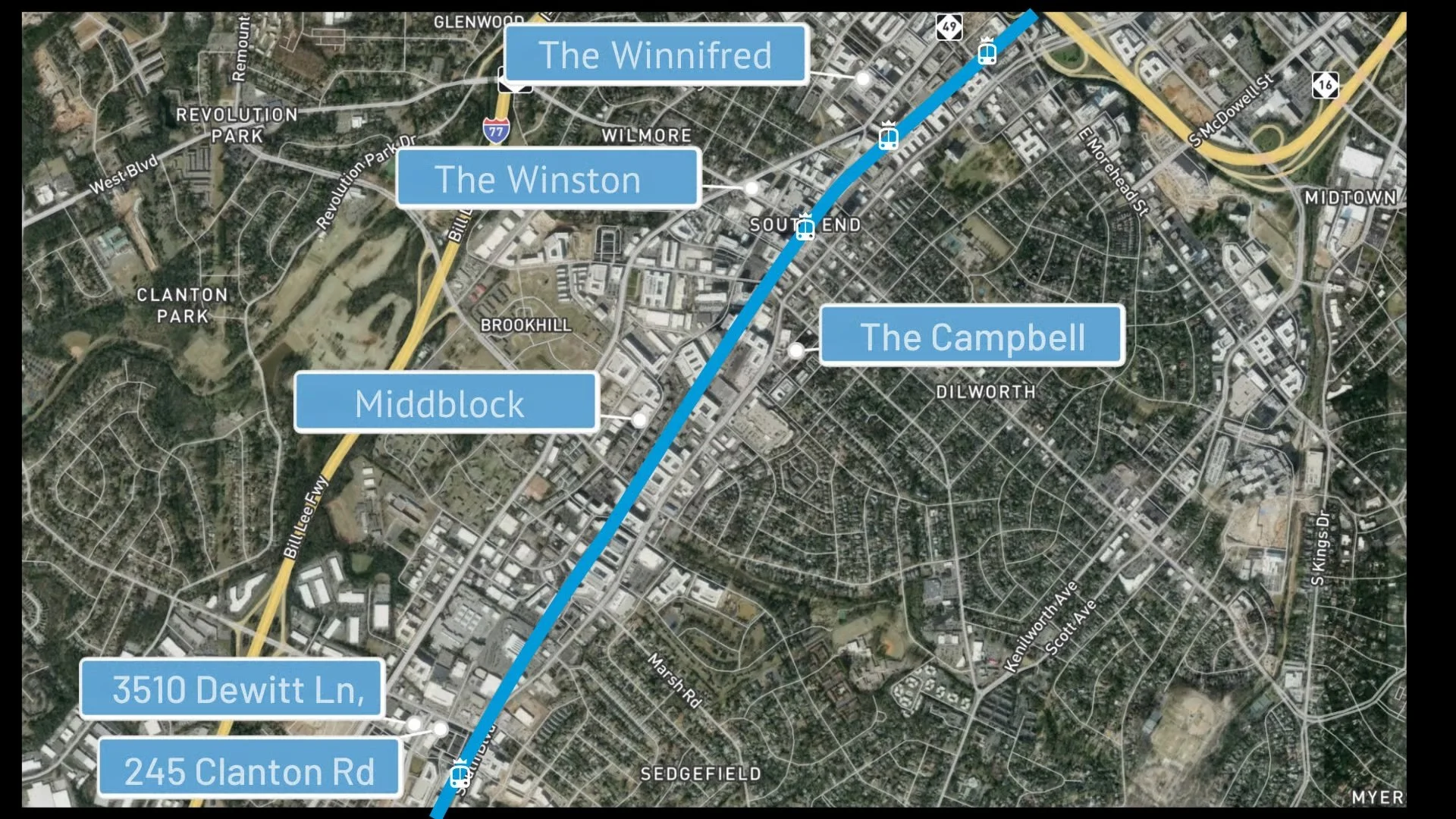
Six listings I'm currently working — Middblock, 3510 Dewitt, The Campbell, The Winnifred, 245 Clanton, and The Winston — all sit within 0.3 miles of a light rail stop. Different locations, different building types, different ownership groups. The only thing they have in common is proximity to rail. That's not a coincidence. That's a signal, and I don't think the market has caught up to it yet.
Recent leasing activity reinforces this dynamic. Capital One's filing for a 10,463-square-foot café-bank hybrid at 1520 S. Tryon St. in South End — combining a full-service Verve Coffee Roasters bar with banking services, a walk-up ATM, patio seating, and bike infrastructure — is a clear signal of the kind of commercial demand TOD rezoning was designed to unlock. A national brand betting on a hospitality-forward, transit-adjacent format at this scale reflects confidence in the walkable, high-density population the corridor now supports, and it's the type of tenant mix (experiential retail paired with daily-need services) that reinforces ridership and street activity rather than just following it.
The six, for the record
Middblock. 3510 Dewitt. The Campbell. The Winnifred. 245 Clanton. The Winston. Six separate deals, six separate owners, one shared address to the same rail line. When that many unrelated assets cluster around the same variable, it stops being anecdote and starts being a market condition.
Retail near rail doesn't behave like retail everywhere else
Standard retail underwriting is built around a car-centric model: drive-by visibility, parking ratios, curb cuts, traffic counts on the adjacent arterial. That model has run Charlotte retail for decades because, for most of the city, it's still correct.
But a retail box within a short walk of a rail stop is playing a different game. Foot traffic there isn't generated by a driver deciding to pull in — it's generated by a commuter who's already moving through the corridor twice a day, rain or shine, whether gas is $2.50 or $4.00 a gallon. That traffic doesn't dip in a downpour. It doesn't require a 40-space parking lot to convert. It doesn't care about visibility from the road, because the customer was never in a car to begin with.
Rezoning to transit-oriented development (TOD) standards has been a critical unlock for density along the corridor. By replacing conventional low-FAR, auto-oriented zoning with TOD overlays, tighter parking minimums, and by-right height/density bonuses near stations, municipalities have made it financially and legally feasible to build at the scale transit ridership actually supports. This matters because density and walkability are mutually reinforcing: higher unit counts within a half-mile walkshed put more residents within reach of transit, which supports the retail and street-level activity that make a corridor walkable, which in turn increases the land value premium developers are willing to pay for TOD-zoned sites. In markets where this rezoning has taken hold, we're seeing the kind of massive density gains that were structurally impossible under legacy zoning — a key driver of the thesis.
That's a fundamentally different demand driver, and most retail underwriting still doesn't have a line item for it.
Why the gap exists
Charlotte's light rail footprint is young enough that most retail brokers and appraisers are still comping these sites against nearby strip retail rather than against transit-adjacent retail in cities where that asset class is mature — think parts of DC, Denver, or Portland. Without local comps, rent gets anchored to the wrong reference class.
Second, a lot of these parcels were built or last leased before the rail line existed, so the in-place rent reflects a pre-transit reality. Renewal and re-tenanting is where the repricing actually happens, and that hasn't fully worked through the corridor yet.
Third, tenant mix hasn't caught up either. The tenants who benefit most from car-free, high-frequency foot traffic — quick-service food, coffee, pharmacy, daily-needs retail, personal services — are still being recruited with a suburban playbook.
Who this matters to
For Landlords: Stop comping rail-adjacent retail against car-dependent strip centers.
For Tenants: A smaller box near daily foot traffic may beat a larger box with more parking.
For Investors: The value add may be in re-underwriting and renovating with an eye towards the new market value.
The prediction
As Charlotte's rail network matures and more of these leases roll, this corridor repricing is going to accelerate — probably faster than most people expect, because once a handful of deals close at the new numbers, appraisers and brokers finally get the comps they need to justify it everywhere else.
The operators who see this before the rent catches up to the foot traffic are the ones who own the corridor in five years. Everyone else will be reading about it after the fact.
I’m curious where people disagree with this. Are Charlotte’s rail-adjacent retail rents already caught up — or is the market still early?